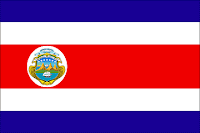
Costa Rican’s identity
The Ticos are gregarious in nature. They are also extremely friendly and full of life. Quick to jump at any and every opportunity to celebrate is what got them the title of being the “PURA VIDA”, which translate to the “people full of happy life”. They are also very family orientated which accounts for their close kin-like relationship with almost everyone.
Gender Roles in Costa Rica
Females used to be subjected to male dominance by doing menial jobs such as housework and taking care of the families. There was distinct gender segregation between them and it was not changed until about 20 years ago (taken from Gender and Education of Costa Rica by Laura Guzman and Anne Letendre Morales). The government made policies and changed legislative laws to such that it caters to women and their education more. The government tried to promote equal living status, work opportunities and eliminate sexism in the country as well as the education system.
Things now are better for the females in Costa Rica, though there are still a few signs of existing sexism. Now it is safe to say that the genders are pretty equal in their country.
 |
Costa Rica’s Architecture
Much of their older architecture like the ones found in the charming town of Barva, located in the central area of Costa Rica, are of Spanish influence due to the colonisation. The Spanish colonial architecture of the seventeenth and eighteenth centuries consist of solid lines and bold structures with the extravagant adornment of the Churrigueresque.
 | |||
| Barva's Architecture |
 |
| Church in Barva |
Costa Rica’s Architecture has its own style, unique to this part of the world. Like all countries, they play with space and volume to design and create built elements where individuals can interact, live, work or admire. However their design tends to be more practical as they design and create the plans based on the needs, area and type of terrain where the structure is to be built.
author's notes:
Costa Rica's architecture is much much complicated than usual architectural design as they are subjected to harsh weather conditions as well volcanic activities. All these mentioned makes it hard for them to preserve any historical buildings and sites as the weather conditions are not under their control. However, the Costa Rican Government bodies have set aside some legislative laws that gives incentives to people, private organizations that help preserve their architecture. This, in my opinion, is very helpful in helping them preserve their cultural and heritage aspect of their country.
author's notes:
Costa Rica's architecture is much much complicated than usual architectural design as they are subjected to harsh weather conditions as well volcanic activities. All these mentioned makes it hard for them to preserve any historical buildings and sites as the weather conditions are not under their control. However, the Costa Rican Government bodies have set aside some legislative laws that gives incentives to people, private organizations that help preserve their architecture. This, in my opinion, is very helpful in helping them preserve their cultural and heritage aspect of their country.
Ethnicity
The Ticos are one of the most homogeneous groups in terms of ethnicity as compared to the rest of the Central America countries as many of them are of Spanish descent. The “whites”, as they call it and the Mestizos (people with a mix of Native American and European ancestry) account for 94% of the total population. The rest of the populations are made up of the Chinese, American Indians and the “Blacks”. The “Blacks” are mainly made up of people with a Jamaican descent.
 |
| Mestizo males |
Minorities
In the northern part of Costa Rica, like Guanacaste and Northern Puntarenas, most of the population are of Indian and the colonial-era descent. They are Hispanic in culture and language and they do speak differently from the central Ticos’ Spanish.
In the eastern part of Costa Rica, Limon Province is where the “Blacks” are situated. During the late 1800's ancestors of Costa Rica's black population came to the country from Jamaica to build railroads and to work on the banana plantations. The Indians of Costa Rica, they are a group of people who are part of the English speaking Protestant group and they were “cut-out” by the rest of the Costa Ricans due to law and work discrimination until 1948. Thus, this part of Costa Rica remains culturally distinct up until the mid-twentieth century.
author's notes:
With this going on, it is evident that there are different culture living within the country and how isolation from the 'main' part of the country retains and preserves culture. This cuts out all the other influences from the surroundings (i.e. from their own countries, neighbouring countries and the world) and helps them retain what is authentic and real. Though many might argue how it seems like a cultural and social segregation from the society, it is evident that with that segregation comes a different form of positive outcome which is retaining local culture. Even if the indigenous groups comes in small numbers due to a myriad of reason, it is still important to see that the preservation of culture comes in many forms, be in good or bad(in this case, segregation), and culture has to be retain in order to keep the authentic roots in the country.
author's notes:
With this going on, it is evident that there are different culture living within the country and how isolation from the 'main' part of the country retains and preserves culture. This cuts out all the other influences from the surroundings (i.e. from their own countries, neighbouring countries and the world) and helps them retain what is authentic and real. Though many might argue how it seems like a cultural and social segregation from the society, it is evident that with that segregation comes a different form of positive outcome which is retaining local culture. Even if the indigenous groups comes in small numbers due to a myriad of reason, it is still important to see that the preservation of culture comes in many forms, be in good or bad(in this case, segregation), and culture has to be retain in order to keep the authentic roots in the country.